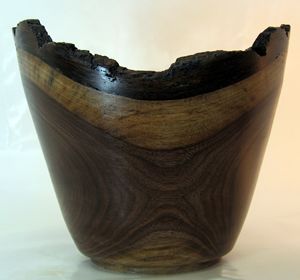
Sycamore Bowl with Red Calcite Inlay #250
Piece #250 – Sycamore & Calcite Inlay – 8″ dia by 3″ – SOLD




Because I wanted to leave as much bark on this piece as possible, I had to carve out the center on the lathe first and then I had to hand carve out the rest. 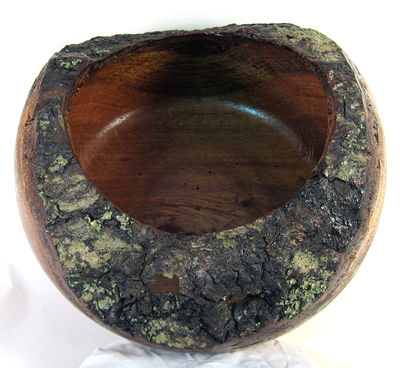

In April 2011 we had a big storm in Knoxville. Lots of trees blew down. This Hackberry tree came down on Nibben Ridge Road. I only picked up two pieces. Now I wish I had taken more. 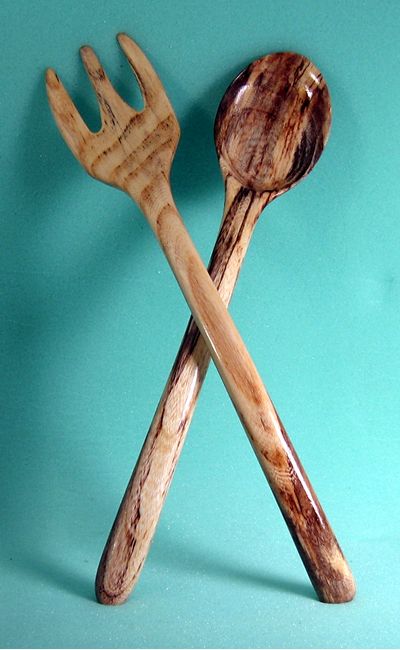
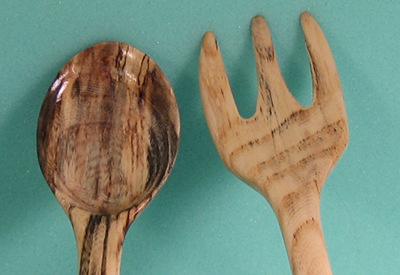

Large pieces of Bradford Pear are hard to come by. Unfortunately, two were blown down in our neighbor’s yard in the spring of 2011. I happened by as the clean-up crew was loading it into their truck. I snagged some of the trunk.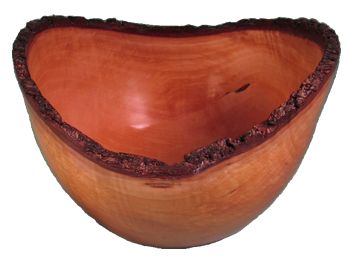

This piece was something new. It is all one piece of wood. It is not glued together. Quite unique. 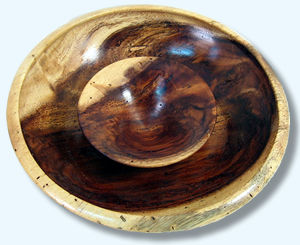 Look at the tiny worm holes in the sap wood.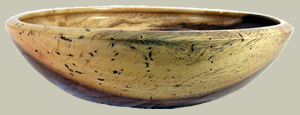
Wow! Allowing both heart wood and sap wood to contrast is is so striking in this Gunacaste piece. I love it.

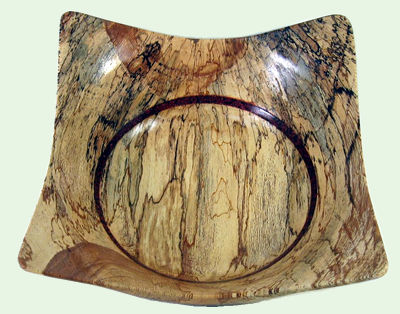
This unusual bowl is square but it looks like the sides are concave. This bowl has a red and black inlaid band down near the inside bottom. It is called “Circle in a Square”.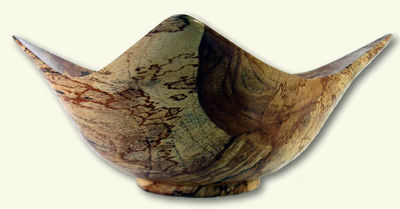
This Sycamore bowl has a natural edge. As you know, sycamore sheds its bark so there is no bark on this piece. However, it does have an unusual edge.

This Magnolia Salad Set is inlaid with green, white and clear Calcite. The Calcite is first crushed and sorted into five different sizes using kitchen strainers. 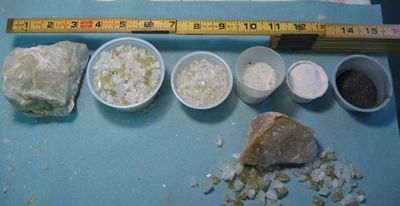 The black comes from mixing the fine Calcite with black carbon dust. The black is used to highlight the inlay and to provide a contrasting base at the bottom of the inlay.
First you must carve out your design, or in this case, the rim around the bowl and the shape on the fork and spoon set.  In the picture at the right I am using a Dremel tool with a high speed boring burr. You must be very precise as you want your edges straight and crisp. Patience and a steady hand are essential.
  The photo below is a close-up of the fork as the burr is carving out the shape. You must stay just inside your pencil lines. It is best to carve straight down into the wood about 5/16 of an inch. Try to keep the bottom as flat as possible.
In the next two photos you can see the completed shape. Notice the straight edges and the depth of the carving. It is important to go deep enough to give your inlay prospective.
The next step is critical. Omitting it will ruin your piece! Using very thin CA glue will stain the wood and it will never come out. You must protect the wood surface from soaking up this thin CA glue. I use a solution of 90% Denatured Alcohol and 10% one pound cut of dewaxed shellac. Mix this and put it in an industrial type spray bottle. Spray a little on your hand. When it drys in a few seconds, your hand should be slightly sticky. If it is, your mixture is the right consistency. Spray this mixture on the surface of the wood. Let it dry a few minutes. Spray on another coat. Let it dry.


In the four photos below you can see the process of inserting the Calcite crystals into the carved out shape. The first step is to place a fine layer of black crystal along the bottom of the design. This provides a contrast at the bottom of your inlay to enhance the depth of the clear crystals.
Next lay in the largest crystals. Use the biggest ones that will fit into the groove, making sure they are “proud” of the top of the wood. Space them out. Use your sense of color and shape to arrange them into the entire carved out groove.
Now fill in around your large crystals with the next smaller size. Pack them in as tightly as you can get them. After your groove won’t accept any more of this size crystal, go to the next smaller size crystal. Sprinkle them in around the larger crystals. You will notice that they fall down to the bottom of your groove and fill in around the larger crystals. Continue until they have filled in completely around the larger crystals.
Using the sugar sized crushed crystal (black and white) fill in all of the holes, voids, cracks and spaces. I sprinkle it on very lightly so that it will fall in around the larger crystals. The idea is to get as much of the groove filled with crystal as possible. In this step when using black crystal, “Less is More”.
I use a large magnifying glass mounted on a scissor arm with a light around it to inspect the placement of the crystal. You might want to vibrate the wood to help the crystal settle into empty pockets. Be careful if you do this as you can easily vibrate everything out of the groove and all over your work bench! You should have a mound of crystal piled up “Proud” of the wood surface as seen in the photo below.
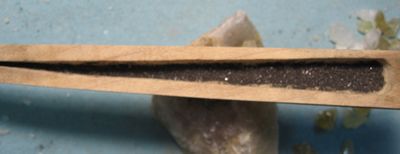

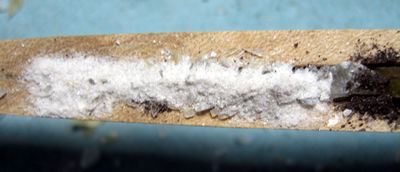
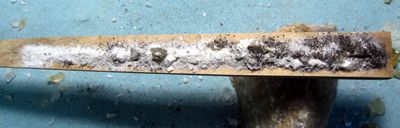
Once you have the crystals loaded into the groove, fill the groove with very thin CA glue. Use the thin CA glue liberally. I mean fill that groove so that the glue is running out and over the sides. Drip it in and let it soak in. Continue until the crystal is drenched. (See the fifth photo down.) Let the CA glue dry for about 30 minutes.
The next step is power sanding. I start with Klingspor 5″ Stearate A/O 40 grit PSA sandpaper discs used on my variable speed drill. You can get them from Klingspor’s Woodworking Shop at www.woodworkingshop.com. As you can see from the photo, the Calcite crystals are all glued together into one solid mass that sets “Proud” of the wood surface. The Calcite must be sanded down flush with the wood. Be careful not to build up too much heat on your sandpaper or the inlay.
After you have power sanded the Calcite down to the wood, inspect the surface of the inlay using a magnifying glass. You will notice that there are a few tiny holes and crevices. You must fill those in with crystal and add more CA glue. But not before you spray the wood surface with the Shellac solution again. Power sand this time using 80 grit paper. Inspect the surface again and repeat the process until the inlay surface is smooth. If the surface is solid, from this point on you will not be using CA glue, so you do not have to spray shellac after sanding.
Power sand the inlay starting with 100 grit and go all the way through 1200 grit. Your Calcite will be polished and gleaming. Finish with the Beal Buffing system.

This piece was purchased at the Oak Ridge Secret City Festival. The finial is oak dyed black. The top is spalted maple and the bottom is Indian rosewood. It is finished with varnish.

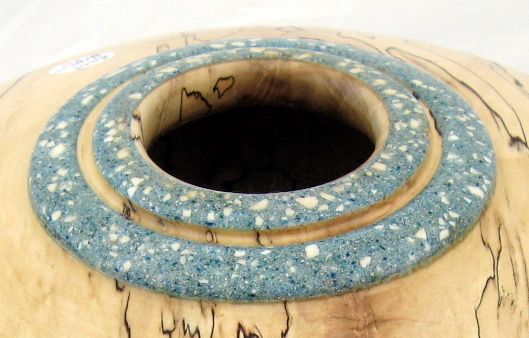
Piece #235 – Spalted Maple with InLace – 9″ dia x 6″ – SOLD
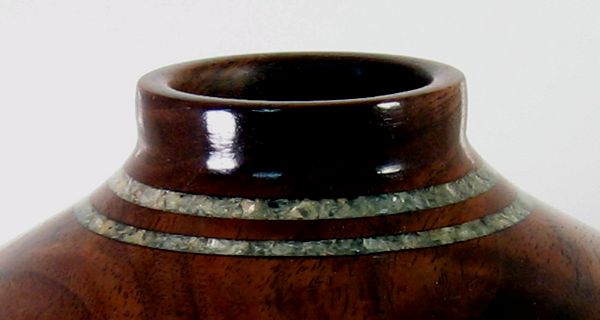
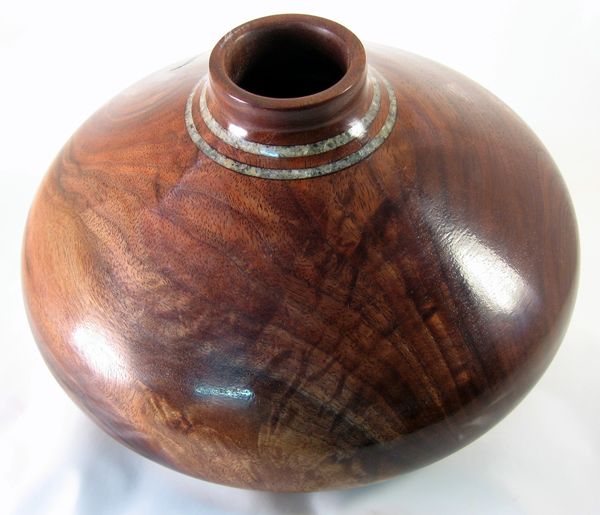
This spalted maple form with the blue inlay rings is a unique piece. It is finished with clear shellac.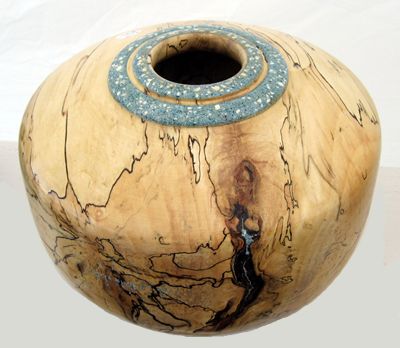
Piece #236 – Bradford Pear – 6.5″ dia x 5.5″ – Sold
This piece came from the winds of the big storm of April 27. It was finished with clear shellac.
This Bradford Pear came from a neighbor”s yard after the storm on April 27th. I love the pinkish color of this wood. I turned this wood green. The crack came from the limb breaking off during the storm. It looks like a jagged wound. The piece was finished with clear shellac.
This piece was sold on June 4th at the Lenoir City Arts and Crafts Festival.
Sold this bowl June 4th at the Lenoir City Arts and Crafts Festival.

I don’t know what this wood is. It came from Ben’s wood cache. It was very old and quite dry. When I turned it a real fine, baby powder like, dust came out of the tiny worm holes.
I used InLace to make the rim and highlight some of the worm holes, which there are many. 

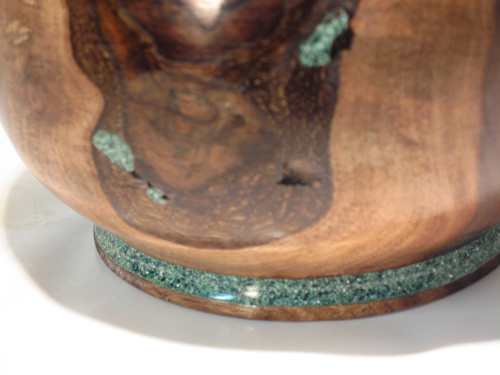
This walnut piece has several noteworthy accents. There is bark that runs from the top all the way down the side. It also has contrasting inlay around the bottom.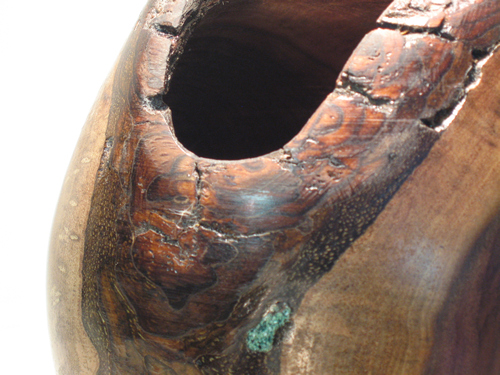
This piece was purchased on June 4th at the Lenoir City Arts and Crafts Festival.

This walnut bowl was made from a piece of wood that Ben Benjamin gave me. I got a truck load of walnut from him.
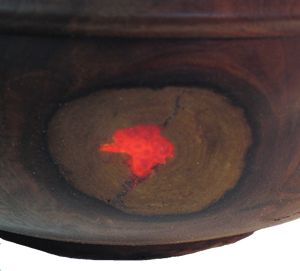 This piece had two knot holes which I filled with red InLace. I used Tung Oil and polyurethane as a final finish. I then buffed it with the Beal Wood Buff system.
Sold this one at the Lenoir City Arts and Crafts Festival on June 4th.
I did a presentation for the Maryville, TN Arts and Crafts Guild in March. It was a big success. I had several people give me seasoned wood that they had in their yard. The material for this bowl came from Rose Marie in Maryville, TN.
In the design stage this piece had a small hidden foot that made it look like it was floating. However, after reverse chucking it to turn the bottom with the foot, it decided to jump off my lathe. Fortunately it did not hit me but it destroyed the bottom of the piece.
At the time I was a little ticked off so I decided to set it aside and come back to it. A week later I put it back on the lathe rounded it out again and finished the bottom flat, as there was not enough wood left on the bottom for the small base.
This small, natural rim, walnut bowl was made from a huge walnut tree that once stood in Dean Enos’s front yard – until nature took it down. Dean and Joyce Enos live in Greenback, TN. I met them at the Foothills Mall Arts and Crafts show this spring.
Dean told me he had a pile of walnut limbs he had been saving in his barn for about four years. “This wood is really seasoned well and ready to turn.” he said. Man was he right. It is a dream to turn. I took four pieces from Dean. So far I have made three pieces from Dean’s walnut tree.
This bowl had an application of tung oil applied an let dry for about a week. Then I put on two coats of Behlen’s Rock Hard Table Varnish – sanding between coats with 320 grit paper. When that had dried about a week or so I buffed it real well with my Beal Buffing System.

We had a really bad storm come through Knoxville on April 27, 2011. A lot of trees were destroyed. This piece comes from a huge Hackberry tree that blew down at 8623 Nubbin Ridge Road. I picked up enough Hackberry for about eight nice size works.
This open form came from a nice size crotch. I turned it green to about 3/4″ wall thickness and then microwaved it about 20 times for 3 minutes letting it cool completely between. I turned it down to its finished size and brown bagged it for a week.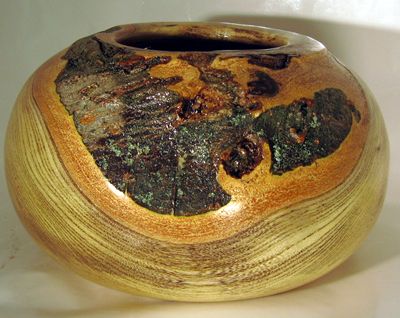
Out of the bag I sanded it from 80 grit through 320 grit. Next I put on a coat of Zinsser 00304 Clear Shellac Finish & Sealer and let it dry about a week. I then put on a very thin coat of Minwax Water Based Stain (Early American), let it soak for about 5 minutes and wiped it off. I let this dry for about a week then put on 3 more coats of the shellac.
This Pet Cremains Urn is made from Black Walnut that I won in a raffle at our local wood turning club. It is finished with 3 coats of varnish.

This beautiful natural edge walnut bowl showcases the difference between the heartwood and the sapwood. It is finished with 5 coats of Minwax Polyacrylic water base topcoat.