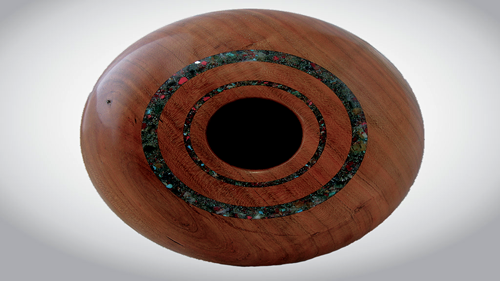
Wild Cherry with Calcite Inlay #515
Wild Cherry with Calcite Inlay #515
Piece #515 – Wild Cherry & Calcite – SOLD


Close up of Calcite Crystal Inlay
Roger Dale Scott
Woodpops

Close up of Calcite Crystal Inlay
Roger Dale Scott
Woodpops
Roger Dale Scott
Woodpops


Close up of Calcite Crystal inlay



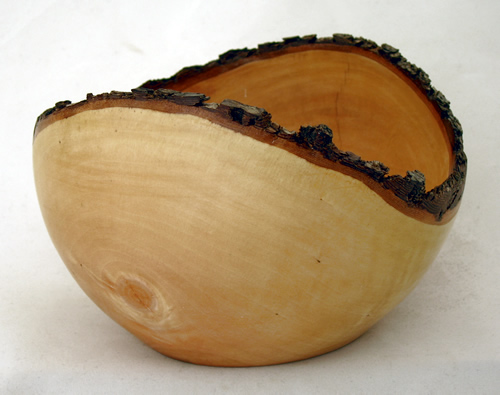


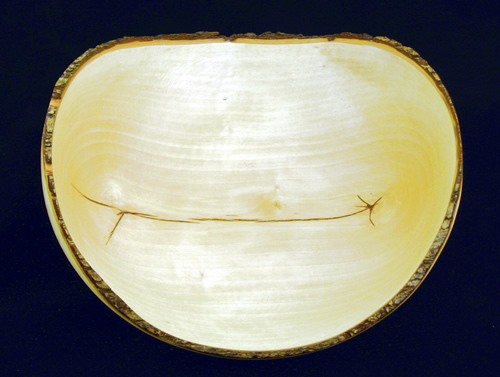


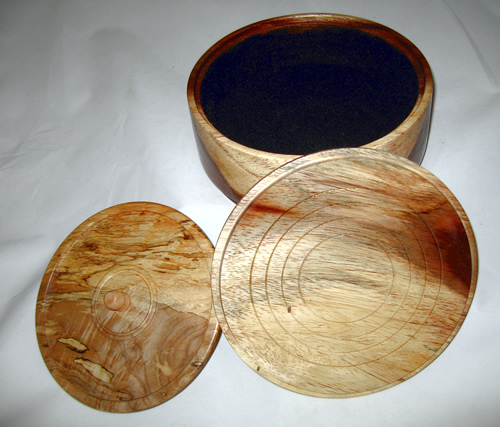


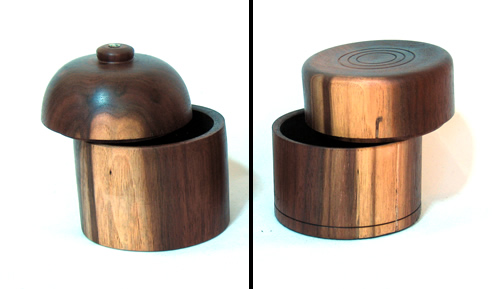

This bowl is made from Bradford Pear. The tree was severely damaged in January 2014 from heavy snow. Our neighbor in Mallard Point had to cut it down and gave me several large pieces. (Georgetown KY)
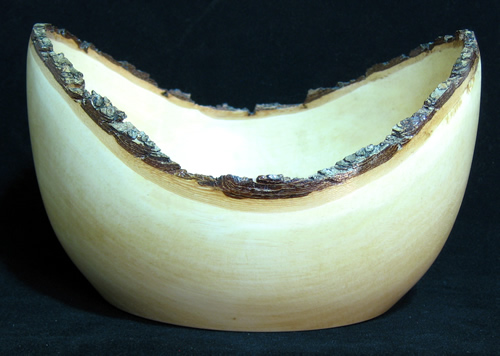


The calcite circle on the rim was cut into the bowl 5/16 inch deep while turning on the lathe. Black calcite was inlaid into the rim. The ring was sanded through 4000 grit sand paper then buffed with tripoli and white diamond polishing paste. The finish on the bowl is Boiled Linseed oil. Several days after that cured I polish the bowl with the Beal buffing system.


I finally finished this piece and it is astonishing. I think my sweet wife is going to exercise her spousal right of first dibs and claim this for herself. Do you blame her?
She loves this bowl. It sat on our dinning room table for about a month and then someone bought it at our Tallahassee Art show. Now she wants me to make her a new one. I’ll get right on it.


The red design on the rim is inlaid calcite and howlite mineral. While the bowl is still on the lathe I cut 3/8″ deep square bottom groove in the rim. Remove it from the lathe and hand place the minerals in the groove. When it is full and pleasing to the eye I carefully squirt very thin CA glue in the groove until it is full up to the edge, without running over. Let that all cure for about three days. Put it back on the lathe and sand the top of the mineral with 80 grit sandpaper. Take it off the lathe and inspect the mineral for any holes in the mineral. Any found are filled with calcite dust and topped with CA glue being careful not to let it get on the wood. Let it cure a couple of days. Put it back on the lathe and sand with 100 grit paper through 4000 grit paper. Polish with tripoli and white diamond past.
The strawberries were masked with frisket and then air brushed with the appropriate translucent colors. The bowl was finished with dewaxed shellac.
Roger Scott
WoodPops


The bunch of grapes was cut into the outside of the bowl 3/16 inch deep with a high speed dental drill using a very small carbide cutting bit. The calcite mineral colors were very carefully selected to match nature’s true colors. The completed piece was polished using Tripoli and white diamond paste on a high speed polishing buffer. It was then finished with Danish Oil and polished with caranuba wax. It is food safe.
Roger Scott
WoodPops


This free standing medallion is turned from Hard Maple. The outside motif is made up of pierced paisley holes. Just inside the motif is a Calcite inlaid circle. The butterfly is inlaid Calcite crystals. It is finished with several coats of satin lacquer.

Display stand included


Closeup of wing

This piece was turned on the wood lathe. I left enough wood thickness at the top rim so that I could hand carve the leaves. This bowl is all one piece; nothing is glued on. Once the leaves were carved I brushed on a one pound cut of dewaxed shellac as a sanding sealer. I sanded the area around the leaves to match the bowl thickness and smoothness. It was intricate and time consuming.
After the leaves and bowl were carved and sanded I masked off all the areas on the bowl around the leaves so that I could air brush the leaves. Several transparent layers were used; the first being yellow. When the leaves were completely air brushed and the paint was dry I used the point of an x-acto knife to scratch in the veins. The leaves were finished with 6 coats of satin lacquer.
Once the lacquer dried and the masking was removed, the bowl surface was sanded to 400 grit sandpaper. Three coats of Danish Oil was applied to the bowl, wiping off any that got on the leaves. I let that dry a week then I buff on caranuba wax with the Beal buffing system. It is food safe.
Roger Dale Scott
WoodPops


This vessel has many layers. First a one pound cut of dewaxed shellac was applied as a sanding sealer. after curing I sprayed a coat of flat black acrylic paint next. When that cured I applied an even coat of Behlen’s Rock Hard Table Varnish. Two days later I applied the copper leaf and let that cure 5 days. To see the application of copper leaf click here.
A chemical patina was created on the copper by using a Sodium Sulfide wash. (Click here to see how.) Once that cured another coat of Behlen’s was applied and left to cure. The leaves were applied individually using silver leaf, copper leaf and faux gold leaf. Each with a different chemical patina to create different colors and effects. There are a total of five layers of leaves applied. After each leaf layer was tarnished another coat of Behlen’s was applied and then another layer of leaves and patina, and so on. Once all of the leaves were complete I carved the smoldering embers using my high speed dental drill. I then masked off the area around them. Using transparent paint in my air brush I added the ember effect. This took sever layers of transparent paint. The veins were added last using a fine line black Sharpie. The final finish is four layers of spray on gloss lacquer. It was then buffed and waxed.
Roger Scott, Woodpops


Silver leaf


This hackberry vase is a little whimsical. The inside is painted sky blue. The white piercing is my interpretation of puffy clouds. The monarch butterflies are painted with my air brush. It is finished with satin lacquer.


This little maple bowl is my interpretation of a pink coral reef. In the center is a colorful Siamese Fighting Fish. It is flanked by Sea Horses. They are done with an air brush. The pink coral is pierced and stippled. The inside is painted deep blue with shadows of Jelly Fish and Stingrays swimming about. It is finished with satin lacquer.


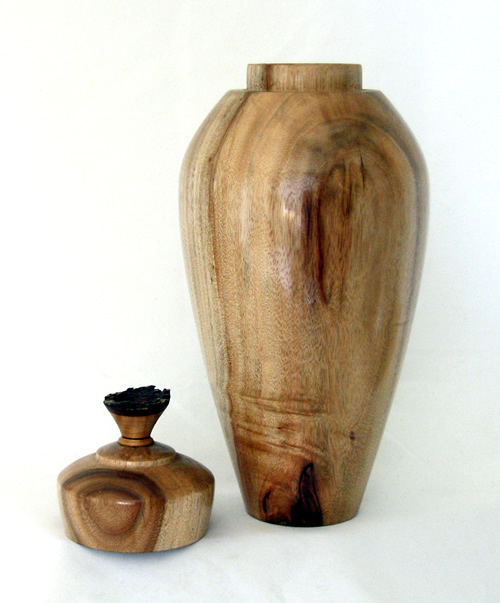
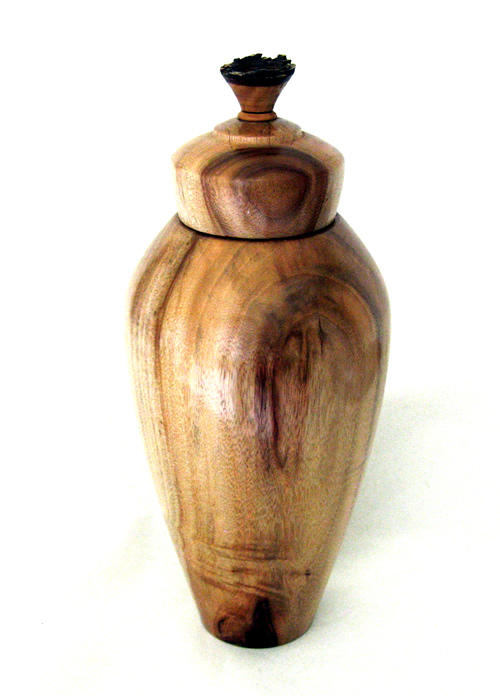
This vessel made of spalted maple has a bradford pear lid. The top of the finial on the lid has a natural edge (bark) rim for that little surprise to draw the eye. The lid mates to the body with threads from PVC pipe fittings. You can tighten this lid and it stays nice and snug. This urn has the grace and balance of a sleek animal. The bottom of the urn has been left solid so there is plenty of weight to keep it steady. The finish on this piece is blond dewaxed shellac. The vessel has an interior dimension of 115 cubic inches. (115 lbs of body weight in cremains ashes).


