Dec 6, 2014
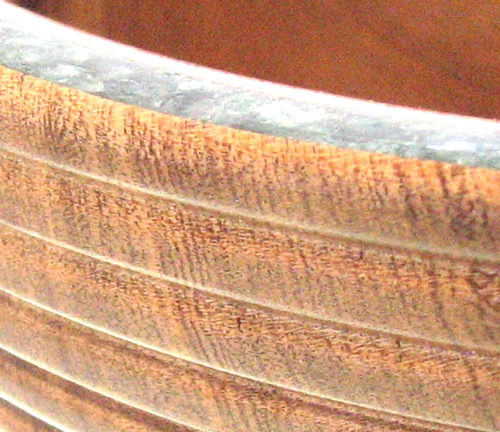
Piece #485 – Elm – 9.5″ by 3.5″ – SOLD
The piece is sanded through 400 grit paper. The two black lines running around the outside of the bowl are made from friction using a wire while the lathe is turning at high speed. The dark area between the lines was scorched with a small butane torch. I applied a liberal amount of Boiled Linseed Oil and let it set for 15 minutes, then wiped off the access and let dry for a week. It is then buffed with the Beal buffing system.

Dec 6, 2014
Piece #484 – Maple with Calcite & Howlite Mineral Inlay – 7.5″ by 1.5″ – SOLD
This free standing bowl was turned on the lathe from Hard Maple. The red design on the rim is inlaid calcite and howlite mineral. While the bowl is still on the lathe I cut 3/8? deep square bottom groove in the rim. Remove it from the lathe and hand place the minerals in the groove. When it is full and pleasing to the eye I carefully squirt very thin CA glue in the groove until it is full up to the edge, without running over. Let that all cure for about three days. Put it back on the lathe and sand the top of the mineral with 80 grit sandpaper. Take it off the lathe and inspect the mineral for any holes in the mineral. Any found are filled with calcite dust and topped with CA glue being careful not to let it get on the wood. Let it cure a couple of days. Put it back on the lathe and sand with 100 grit paper through 4000 grit paper. Polish with tripoli and white diamond paste.
The butterfly is sketched in. I use a high speed dental drill with a carbide bit to remove all the wood within the lines. This leave a 3/16 inch deep impression of the butterfly. I crush and sort my minerals according to size and color. I hand place each piece of calcite like an artist uses his paints. When it looks good I carefully squirt very thin CA glue into the butterfly. Use plenty, but not too much. I set it aside to cure then follow the same procedure as above.
This treasure can be displayed upright on its display stand or it can sit flat on your coffee table to be picked up and admired by your friends.
Roger Scott
WoodPops
To purchase this item go to my Etsy Shop. http://etsy.me/1aezvAw


Dec 6, 2014
Piece #483 – Maple with Calcite & Howlite Mineral Inlay – 6″ by 1.5″ – Sold
This attractive, small decorative dish was made specifically for the Columbus Winterfair Art Show. It was the second piece I sold on the first day of the show. I knew it would go quick.
The inlay on the rim is white Calcite dyed red and green along with red Howlite. There is also a smattering of clear optical grade Calcite in the rim. The Holly idea came from my Muse. She thought it would be perfect for the show. As usual, she was right. The dish was sanded through 5000 grit sandpaper. A liberal amount of Danish Oil was applied to the piece for about 15 minutes, then the access that did not soak in was wiped off. After the dish dried for about a week I buffed it using tripoli and white diamond compound. I then applied carnauba wax with the Beal polishing wheel.


Dec 6, 2014
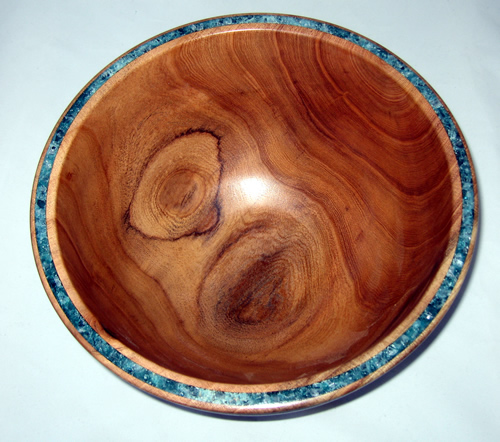
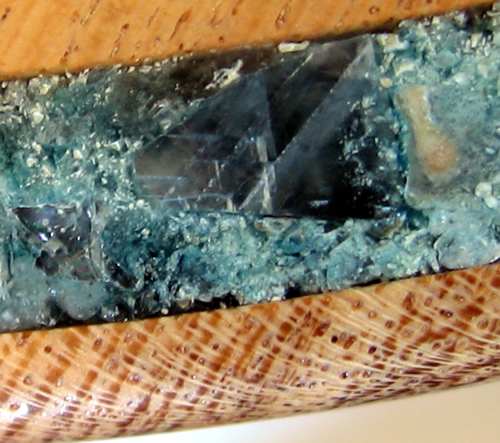
Piece #482 – Elm with Calcite & Howlite Mineral Inlay – 10″ by 4″ – Sold
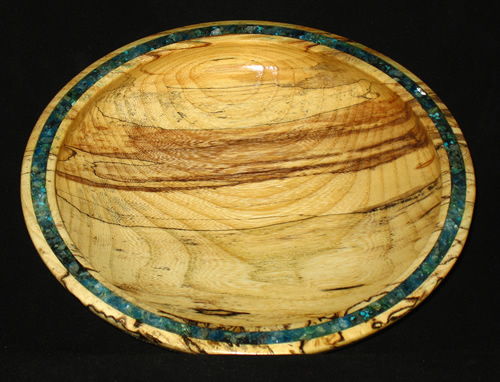
The inlaid rim on this Elm bowl is made of Calcite and Howlite; the process is explained on this link https://woodpops.com/about-2/inlay/. The bowl was finish sanded to 400 grit paper. The finish is Danish Oil.


Dec 6, 2014
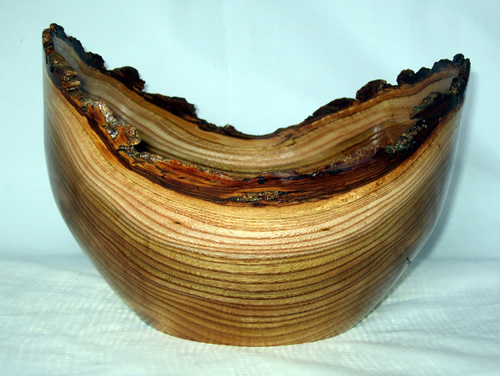
Piece #481 – Green Ash – 13″ by 5″ – SOLD
This odd shaped bowl was turned green and dried using our microwave oven. I set the microwave on high and heat the bowl for 3 minutes. I remove it and let it cool completely. Repeat the process until you see no more steam coming off the bowl. Any small cracks that may appear are sealed and stabilized with very thin CA glue. The piece is sanded through 180 grit paper.
I wanted this piece to look like aged Ash so I covered it with black leather dye and let it dry for 2 days. I then sanded the piece with 180 grit paper to remove all of the dye on the high spots leaving the black dye that had wicked into the end grain. I then ragged on a very light coat of Aged Oak stain. After completely dry I sanded through 400 grit. Then I applied a liberal amount of Boiled Linseed Oil and let it set for 15 minutes, then wiped off the access and let dry for a week. The piece is finished with six coats of dewaxed Shellac. After a week of drying it is then buffed with the Beal buffing system.

Dec 6, 2014
Piece #480 – Green Hackberry – 10″ by 5.5″ – Sold
This form was turned green. (right after harvesting) I dried it using our microwave oven. I set the microwave on high and heat the bowl for 3 minutes. I removed it and let it cool completely. Repeat the process until you see no more steam coming off the bowl. The piece is sanded through 400 grit paper. I applied a liberal amount of Boiled Linseed Oil and let it set for 15 minutes, then wiped off the access and let dry for a week. I finished it with six coats of dewaxed Shellac. It is then buffed with the Beal buffing system.
Dec 6, 2014
Piece #479 – Ash – 10″ by 6″ – SOLD
The piece is sanded through 400 grit paper and finished with six coats of dewaxed Shellac. It is then buffed with the Beal buffing system.
Dec 5, 2014
Piece #478 – Tropical Almond, Orange Osage, Cherry, Walnut – 8″ by 10.5″ – SOLD
This lidded Urn or Vessel is made of four different species of wood. The main body is Tropical Almond. The collar between the lid and the body is Orange Osage. The lid is Wild Cherry and the finial is Walnut. The piece is sanded through 400 grit paper and finished with six coats of dewaxed Shellac. It is then buffed with the Beal buffing system.
This urn will hold up to 100 cubic inches of ash remains, (100 pounds precremation weight).

Dec 5, 2014
Piece #477 – Elm with Calcite Inlay – 10″ by 5″ – SOLD
The inlaid rim on this Elm bowl is made of Calcite; the process is explained on this link https://woodpops.com/about-2/inlay/. The Salad Hands are also inlaid with the same calcite. The finish on this bowl and treenware is Boiled Linseed Oil. After thoroughly drying, it is buffed with the Beal buffing system.

Dec 5, 2014
Piece #476 – Black Walnut – 9.5″ by 3.5″ – SOLD
This dark salad bowl with Salad Hands treenware makes a great gift. The pieces were sanded through 400 grit sandpaper. Pure Tung Oil was liberally applied and allowd to soak in for 30 minutes, then any access was wiped off. Four days latter the process was repeated. Four days later the process was repeated again. After four more weeks it was buffed with 0000 steel wool and then buffed with the Beal buffing system.

Dec 5, 2014
Piece #475 – Willow with Calcite Inlay – 10.5″ by 3.5″ – SOLD
This Willow bowl has twin red calcite and howlite rings inlaid into the rim. The rings were sanded through 5000 grit sand paper then buffed with tripoli and white diamond polishing paste. The finish on the bowl is Boiled Linseed oil. After that has soaked in and thoroughly dried I wipe on a thin coat of one pound cut dewaxed shellac. Several days later I polish the bowl with the Beal buffing system


Dec 5, 2014
Piece #474 – Maple with Obsidian Inlay – 10″ by 4″
This is a flawless, classic bowl. It is finished with blond dewaxed shellac. I buy colorless shellac flakes and dissolve them in Denatured Alcohol. I brush on a one pound cut as a sanding sealer. After sanding to 380 grit sandpaper I brush on three coats of two pound cut shellac. Sanding with 400 grit between coats. I finish by wiping on a finale coat of one pound which removes any brush strokes I might have missed. I buff with the Beal buffing system.


Aug 4, 2014
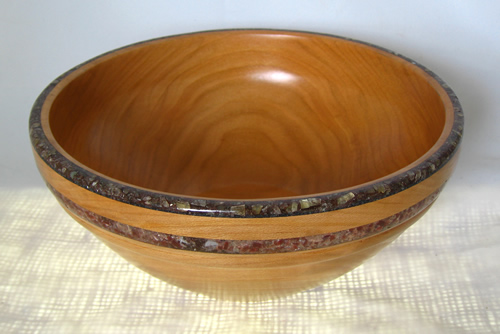
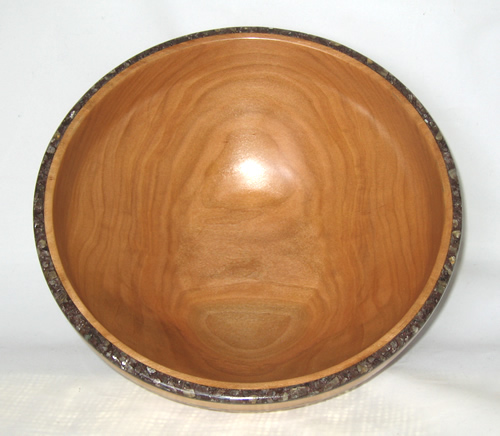
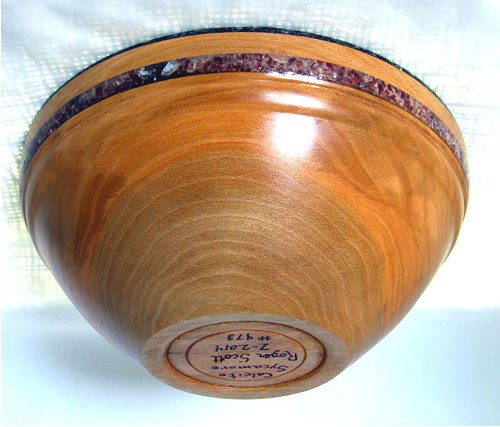
Piece #473 – Sycamore with Calcite Inlay – 10″ by 4.5″ – SOLD


Aug 4, 2014
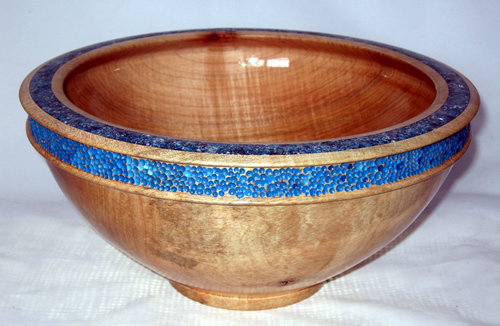
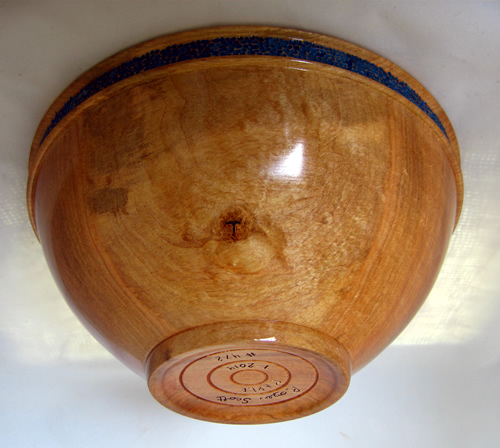
Piece #472 – Maple with Textured & Calcite Inlay – 11.5″ by 5.5″ – SOLD ON ETSY
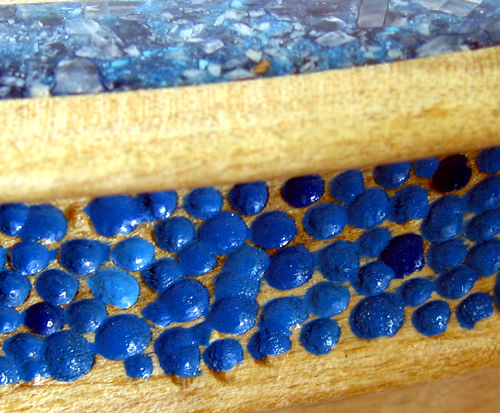
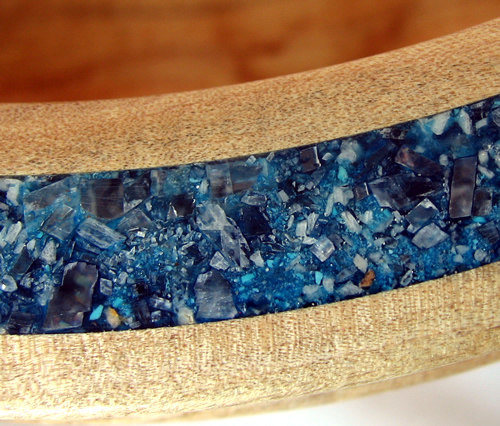
This specimen Maple bowl is perfect. The undercut rim is inlaid with blue, white and transparent Calcite. The top edge is stippled and each dimple i hand painted.
Roger Scott, Woodpops
Stippled Texturing is Hand Painted


Close up of Stippled, hand painted top

Close Up of Calcite Inlay

Aug 4, 2014
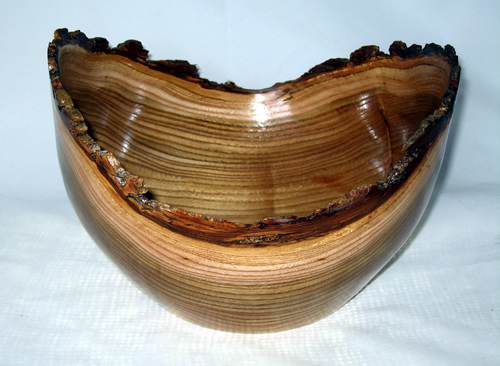
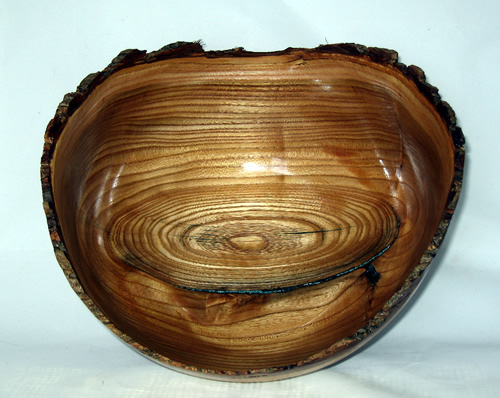
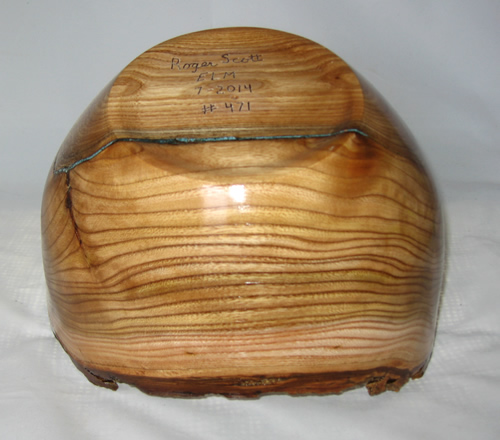
Piece #471 -Elm – 9.5″ by 6.5″ – SOLD


Aug 4, 2014
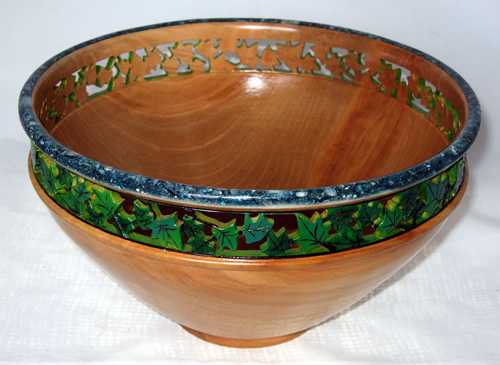
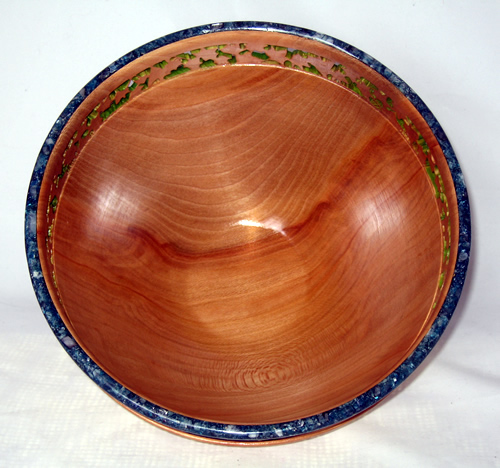
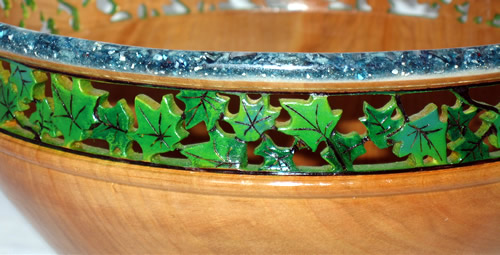
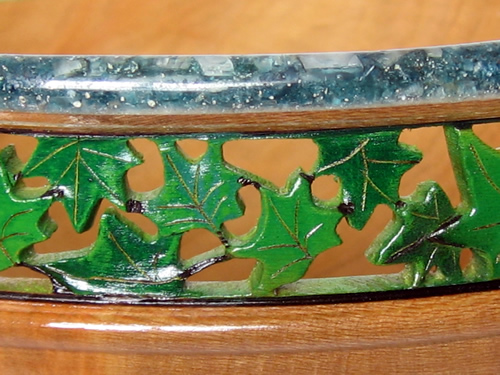
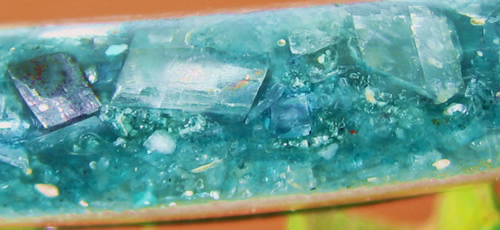
Piece #470 – Sycamore with Calcite Inlay & Pierced Ivy – 9.5″ by 6″ – Sold
This exquisite Sycamore bowl would make a timeless piece to anyone’s collection. It starts out as a flawless sycamore bowl. The top of the bowl has a delicate, outside round over bead; difficult to achieve. Definition is given to the pierced and carved ivy with top and bottom black lines burned in with a wire. The ivy is pierced, carved, air brushed and burned. The bowl is finished with lacquer then buffed to a high luster.
Roger Dale Scott, Woodpops


Aug 4, 2014
Piece #469 – Walnut with Calcite Inlay – 10.5″ by 5″ – SOLD

Four Beads plus Rim

Calcite Inlay

Aug 1, 2014
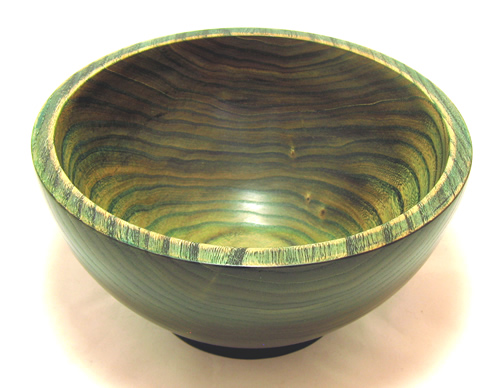
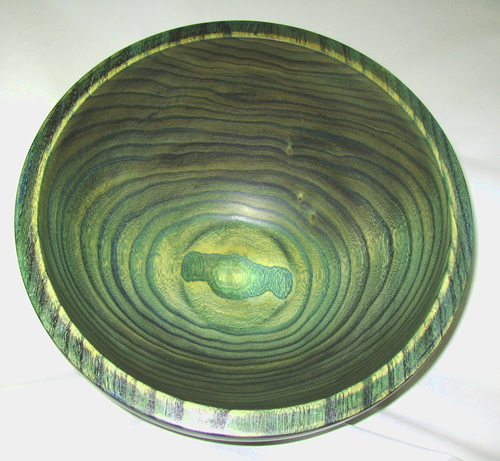
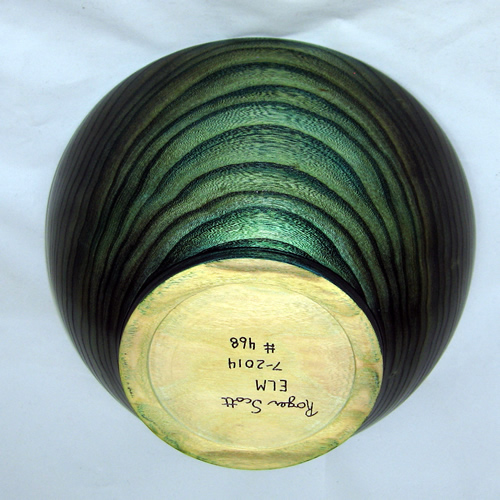
Piece #468 – Elm Dyed Green – 10.5″ by 5.5″ – SOLD


Aug 1, 2014
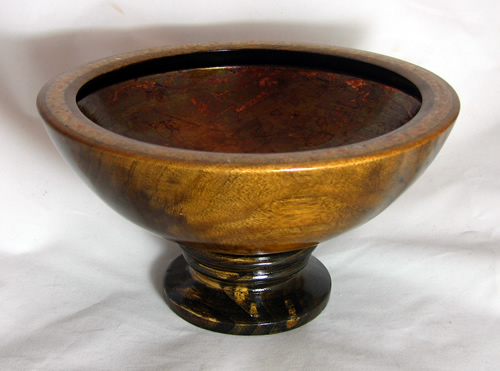
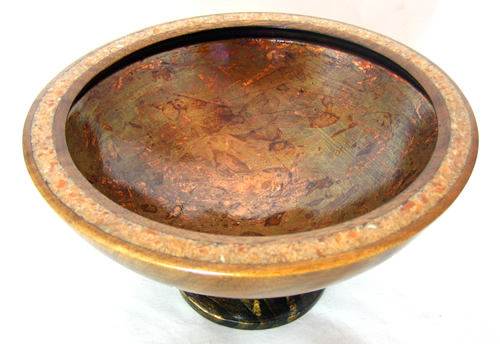
Piece #467 – Walnut with Orange Calcite inlay & Copper Leaf – 9″ by 5″ – SOLD
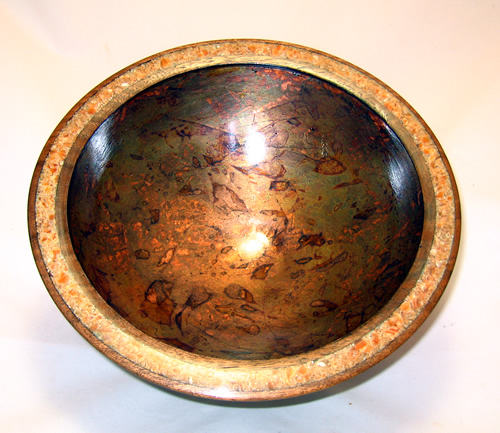
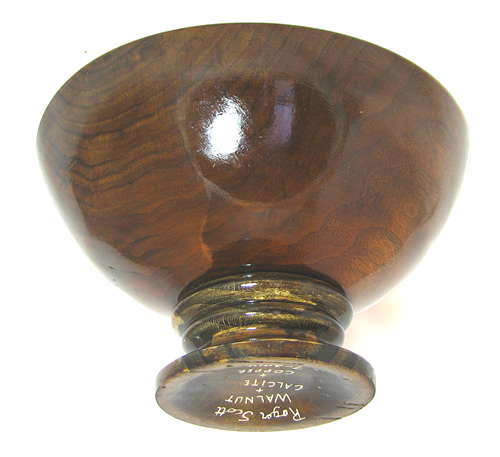
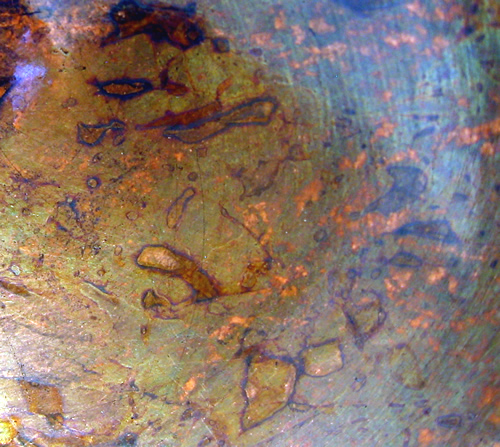
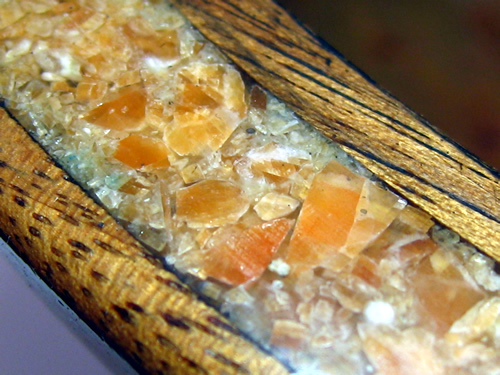
This bowl has quite the history. It started as a plain walnut bowl with an orange Calcite inlaid rim. As I parted it off of the tenon I accidentally cut through the bottom. “Ouch!” To fix the hole I added the pedestal bottom. I thought I would put a Calcite inlaid sunflower in the bottom. After a failed attempt at this I tossed the bowl on the reject shelf. About 18 months later I picked it up and gave it a new look. A Copper leaf sleeve put into the bottom would cover the failed sunflower. A chemical patina completed the Copper inside.
Roger Scott, Woodpops
Walnut

Calcite Rim, Copper Leaf Inside

Copper Chemical Patina


Copper with Chemical Patina

Orange Calcite Inlay

Aug 1, 2014
Piece #466 – Camphor, Copper Leaf – 4.5″ by 8″ – SOLD
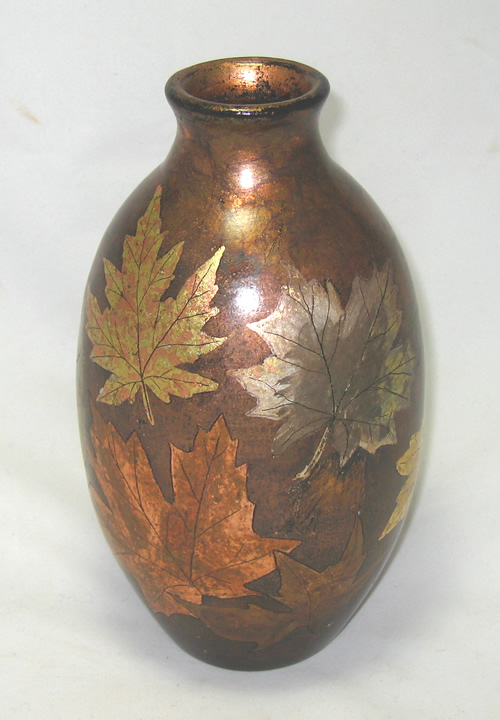
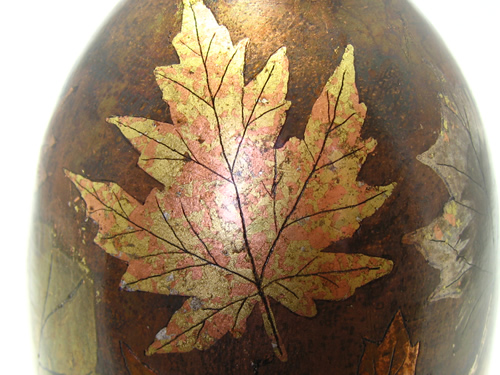
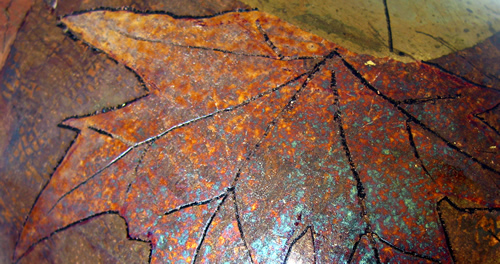
This vase has many layers of finish. First a one pound cut of dewaxed shellac was applied as a sanding sealer. I sprayed a coat of flat black acrylic paint next. When that cured I applied an even coat of Behlen’s Rock Hard Table Varnish. Two days later I applied the copper leaf and let that cure 5 days. To see the application of copper leaf click here.
A chemical patina was created on the copper by using a Sodium Sulfide wash. (Click here to see how.) Once that cured another coat of Behlen’s was applied and left to cure. The leaves were applied individually and are silver leaf, copper leaf and faux gold leaf, each with a different chemical patina. After each leaf was tarnished another coat of Behlen’s was applied.
Roger Scott, Woodpops


Silver with Natural Tarnish

Jul 31, 2014
Piece #465 – Dyed Spalted Hackberry with Black Calcite & Obsidian inlay – 12.5″ by 3″ – SOLD
This spalted Hackberry bowl has many features to separate it from others. The natural spalting effect is quite striking. First I stabilized any checking with very thin CA glue and sanded. To play off of the great spalting and to enhance the wood grain I treated the wood with Tannis and Iron Water. Then I heavily sanded most of the surface blackened wood away leaving the blackened sub grain. Next I washed the wood with a very light yellow dyed Denatured Alcohol solution then sanded lightly. I sealed the wood with Dewaxed Shellac then put on several coats of my secret tung oil finish. After curing for four weeks the bowl was buffed and polished.
The inside bead sets proud of the surface of the bowl and rolls over the inside edge. It is made of clear Calcite dyed black, Obsidian, and white Calcite highlights. It was sanded and polished through 4000 grit paper and then polished with Tripoli and white diamond paste on a buffing wheel. It is quite lovely.
Roger Scott, Woodpops


Jul 31, 2014
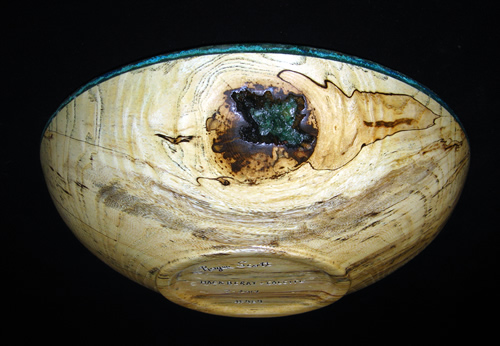
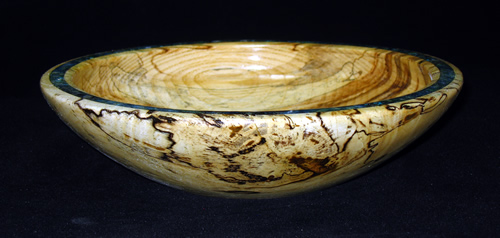
Piece #464 – Spalted Hackberry with Green Calcite inlay – 12″ by 3.5″ – SOLD
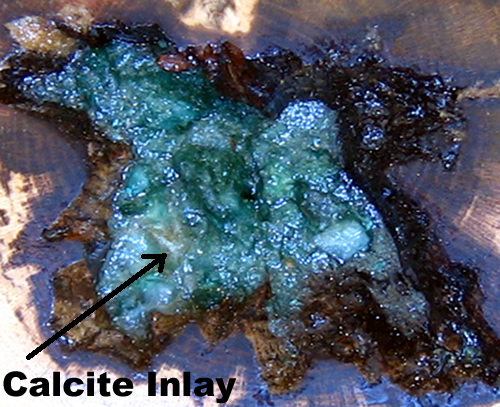
This epic spalted Hackberry bowl had a branch that rotted off of the tree part that it came from. Rather than leave the hole that it left in the bowl, I filled it in with Calcite dust. On the inside of the bowl I polished it to a high luster. (See on upper right dark spot in first photo below.) The outside of the bowl had a rough inclusion where the branch rotted off. I left the rough Calcite show into the inclusion for added character. (Third photo below.)
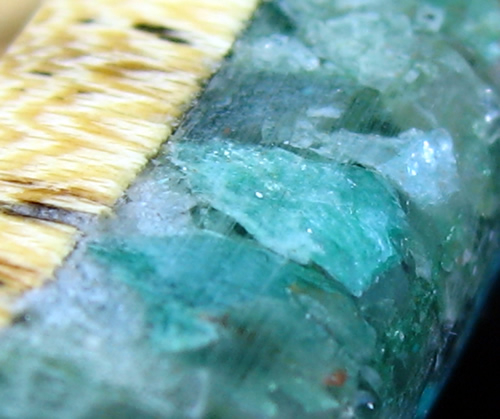
The rim of the bowl has a rounded over outside Calcite bead for added beauty. As I said, “This bowl is Epic.”
Roger Scott, Woodpops


Close up of Outside of Knot Hole Inlay

Calcite Rim

Jul 31, 2014
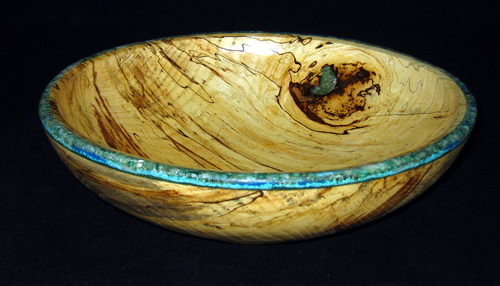
Piece #463 – Spalted Hackberry with Blue Green Calcite inlay – 8.5″ by 2″ – SOLD


Jul 31, 2014
Piece #462 – Dyed Spalted Hackberry with Calcite inlay – 7″ by 1.5″ – SOLD


Jul 31, 2014
Piece #461 – Chestnut Oak with Calcite inlay – 12.5″ by 4″
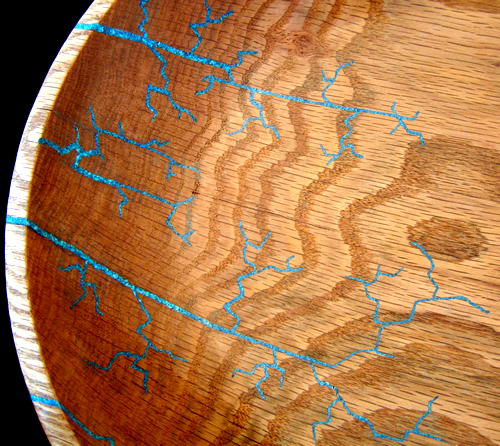
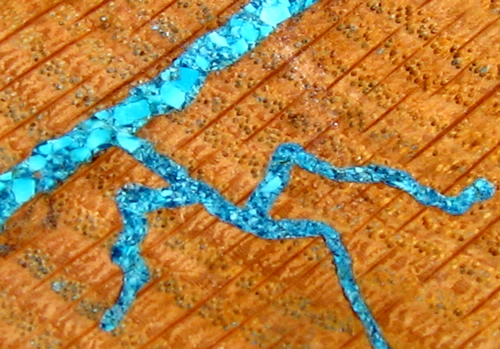
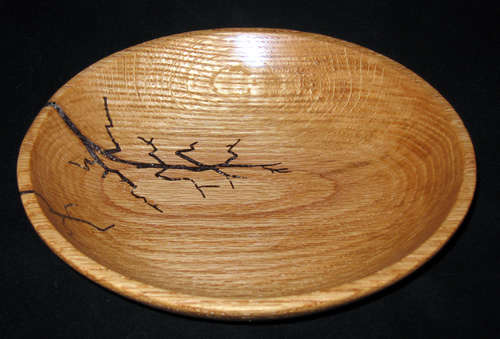
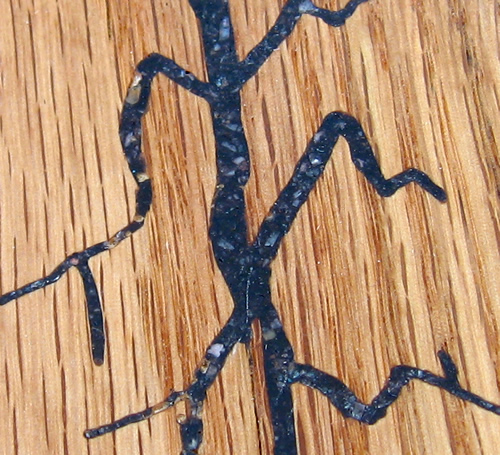
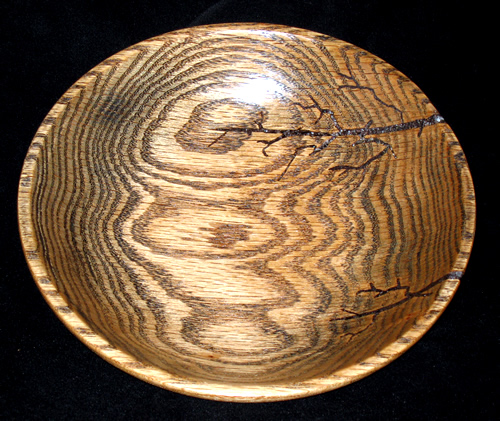
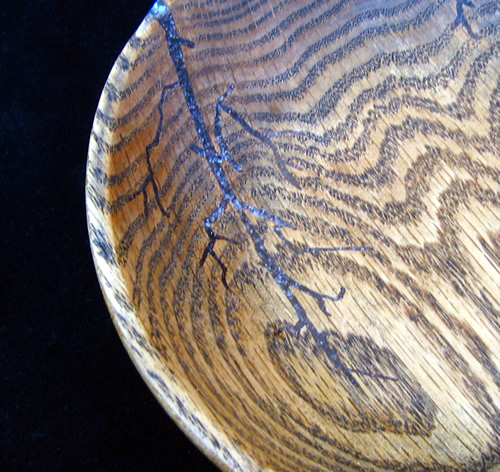
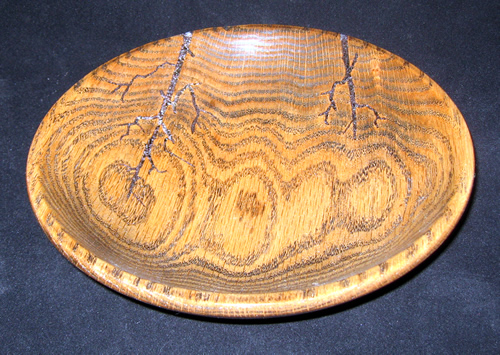
This is the fourth piece in a series called “Fault Lines”. The wood came to me as a result of a really bad thunderstorm in Knoxville, TN, Spring 2011. This huge Chestnut Oak was blown down across the road about 1 mile from my house. The County road service cut it into manageable pieces and moved it out of the way. I came the next day in my pick-up truck to obtain a piece. It took Carolyn and me both to manhandle it up a ramp into the truck.
All four bowls in this series came out of the same cross section of the trunk. The piece was so big that it checked in several places. The figure was so nice I did not have the heart to throw it away. After studying it awhile I received the revelation to incorporate the checks into the design of the four bowls. I am really pleased at how they turned out. I got a resounding “WOW!” from my muse when she saw them. That’s the ultimate show of approval for me.


Jul 19, 2014
Piece #460 – Chestnut Oak with Calcite, Howlite Inlay – 13″ by 2.5″
This is the third piece in a series called “Fault Lines”. The wood came to me as a result of a really bad thunderstorm in Knoxville, TN, Spring 2011. This huge Chestnut Oak was blown down across the road about 1 mile from my house. The County road service cut it into manageable pieces and moved it out of the way. I came the next day in my pick-up truck to obtain a piece. It took Carolyn and me both to manhandle it up a ramp into the truck.
All four bowls in this series came out of the same cross section of the trunk. The piece was so big that it checked in several places. The figure was so nice I did not have the heart to throw it away. After studying it awhile I received the revelation to incorporate the checks into the design of the four bowls. I am really pleased at how they turned out. I got a resounding “WOW!” from my muse when she saw them. That’s the ultimate show of approval for me.


Jul 19, 2014
Piece #459 – Chestnut Oak with Calcite, Obsidian Inlay – 8.5″ by 2″ – SOLD
This is the second piece in a series called “Fault Lines”. The wood came to me as a result of a really bad thunderstorm in Knoxville, TN, Spring 2011. This huge Chestnut Oak was blown down across the road about 1 mile from my house. The County road service cut it into manageable pieces and moved it out of the way. I came the next day in my pick-up truck to obtain a piece. It took Carolyn and me both to manhandle it up a ramp into the truck.
All four bowls in this series came out of the same cross section of the trunk. The piece was so big that it checked in several places. The figure was so nice I did not have the heart to throw it away. After studying it awhile I received the revelation to incorporate the checks into the design of the four bowls. I am really pleased at how they turned out. I got a resounding “WOW!” from my muse when she saw them. That’s the ultimate show of approval for me.


Jul 19, 2014
Piece #458 – Chestnut Oak with Calcite, Obsidian Inlay – 8″ by 2″ – SOLD
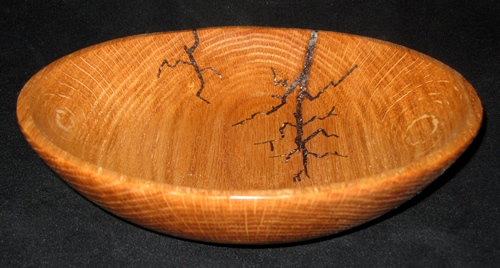
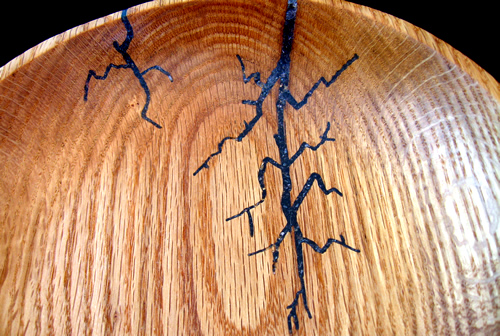
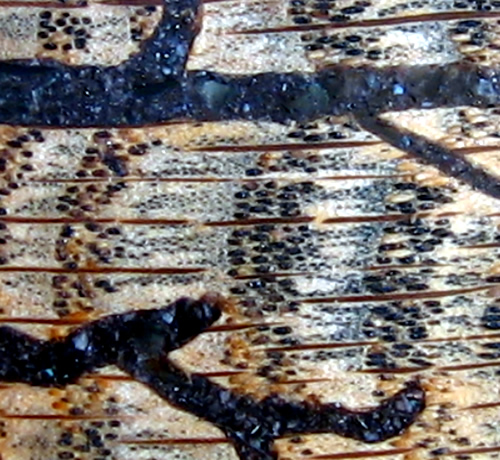
This is the first piece in a series called “Fault Lines”. The wood came to me as a result of a really bad thunderstorm in Knoxville, TN, Spring 2011. This huge Chestnut Oak was blown down across the road about 1 mile from my house. The County road service cut it into manageable pieces and moved it out of the way. I came the next day in my pick-up truck to obtain a piece. It took Carolyn and me both to manhandle it up a ramp into the truck.
All four bowls in this series came out of the same cross section of the trunk. The piece was so big that it checked in several places. The figure was so nice I did not have the heart to throw it away. After studying it awhile I received the revelation to incorporate the checks into the design of the four bowls. I am really pleased at how they turned out. I got a resounding “WOW!” from my muse when she saw them. That’s the ultimate show of approval for me.
To highlight the figure I applied a solution of Iron Water. When it dried I sanded the resulting black finish off to reveal the grain.


Jul 19, 2014
Piece #457 – Ash with Bark Inclusion – 9″ by 3″ – SOLD


Jul 19, 2014
Piece #456 – Elm with Calcite Inlay – 11.5″ by 4″ – SOLD
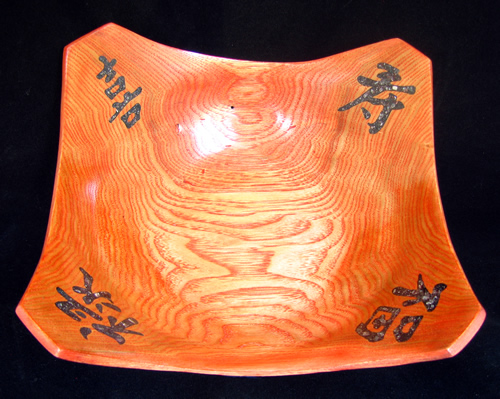
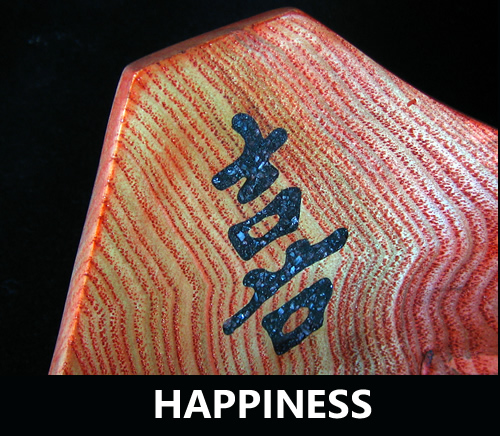
The Chinese characters for Happiness, Longevity, Luck and Prosperity adorn this elm, square bowl. It presents a suggestion of a pagoda roof. The characters were carved 1/8th inch deep with a dental drill then inlaid with calcite crystals. The calcite was polished to a high gem like sheen.