Small Faulted Bowl # 458

Small Faulted Bowl # 458

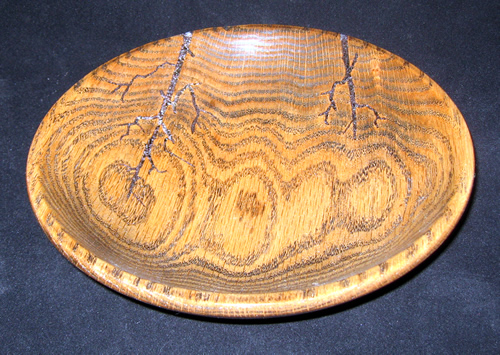
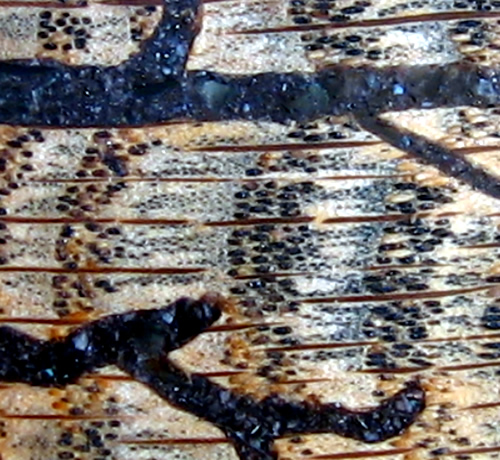
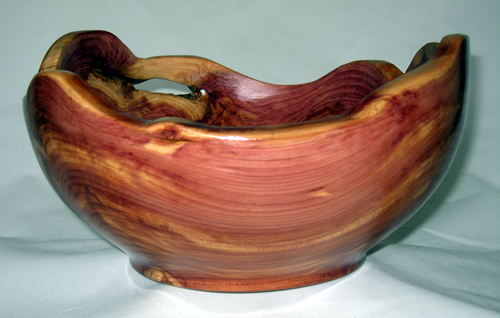
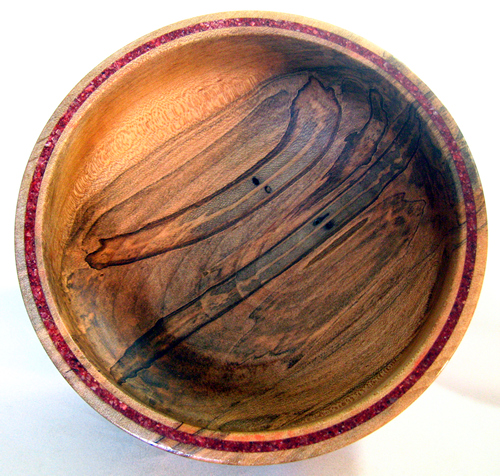
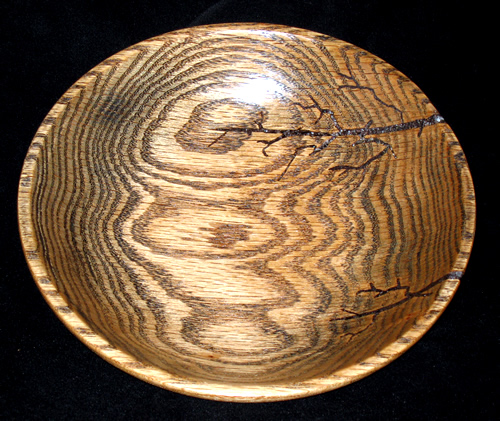
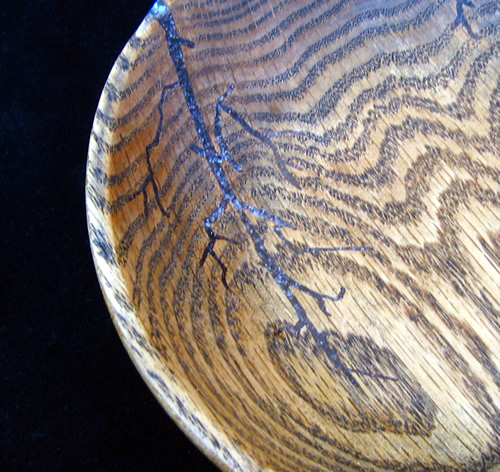
Piece #458 – Chestnut Oak with Calcite, Obsidian Inlay – 8″ by 2″ – SOLD


This is the first piece in a series called “Fault Lines”. The wood came to me as a result of a really bad thunderstorm in Knoxville, TN, Spring 2011. This huge Chestnut Oak was blown down across the road about 1 mile from my house. The County road service cut it into manageable pieces and moved it out of the way. I came the next day in my pick-up truck to obtain a piece. It took Carolyn and me both to manhandle it up a ramp into the truck.

All four bowls in this series came out of the same cross section of the trunk. The piece was so big that it checked in several places. The figure was so nice I did not have the heart to throw it away. After studying it awhile I received the revelation to incorporate the checks into the design of the four bowls. I am really pleased at how they turned out. I got a resounding “WOW!” from my muse when she saw them. That’s the ultimate show of approval for me.

To highlight the figure I applied a solution of Iron Water. When it dried I sanded the resulting black finish off to reveal the grain.
458b458c458a458d

Eastern Closed Form # 455

Eastern Closed Form # 455

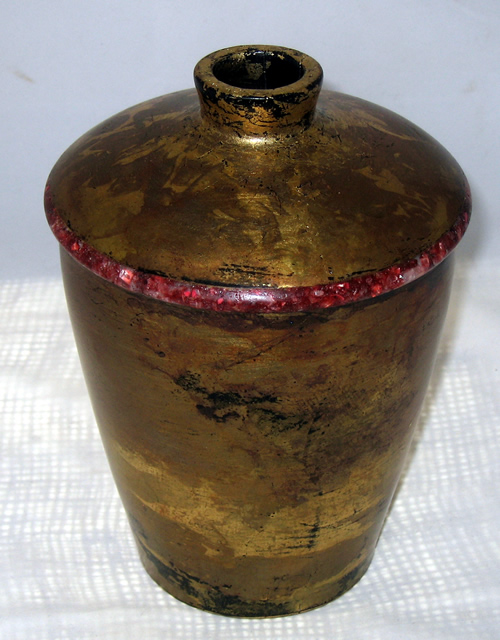
Piece #455 – Sycamore with Calcite, Howlite Inlay – 5″ by 7″


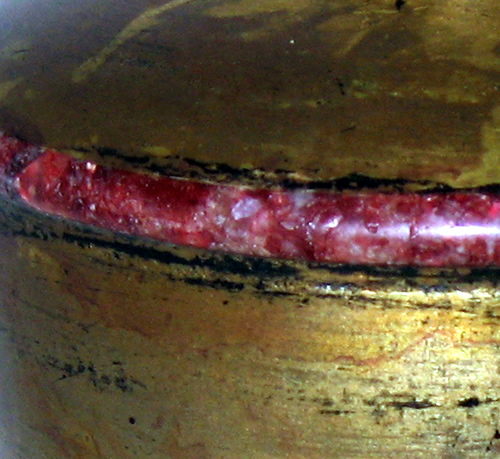
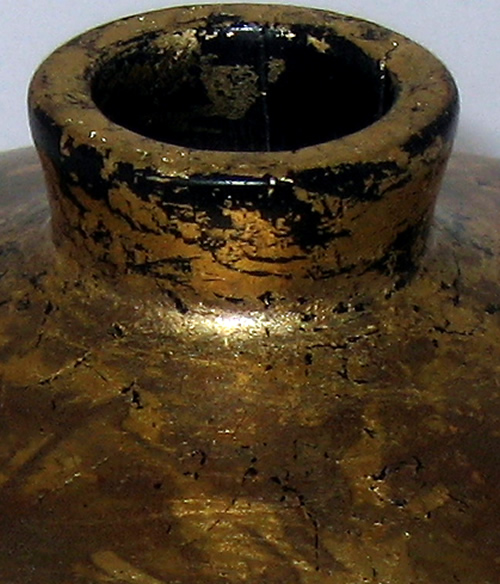
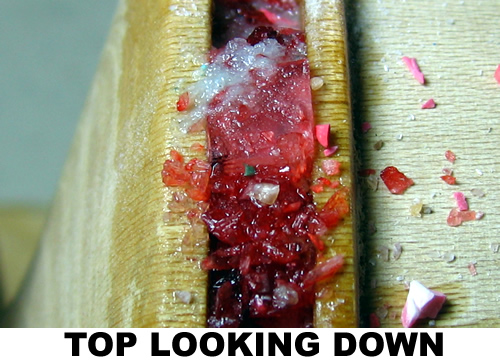
A Sycamore Urn turned on the lath. At the transition of top and sides is a red Calcite bead. After the piece came off of the lath it was sanded to 400 grit sandpaper. A one pound cut of dewaxed shellac sealed the vessel. Next it was spray painted with black latex. When that cured it was brushed over with Behlen’s Rock Hard Varnish.

After curing several days it was ready to apply the fake Gold Leaf. To see this process go to http://youtu.be/BKY2Rj1snJs.

455a455b455c

455f455h455g

Tarnished Silver Rice Bowl # 450

Tarnished Silver Rice Bowl # 450

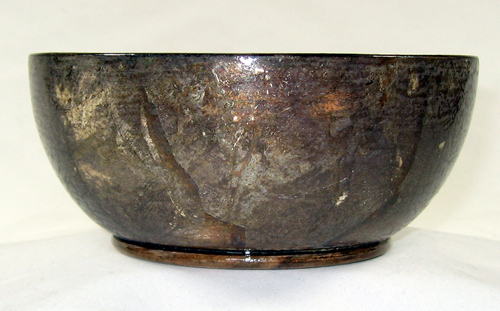
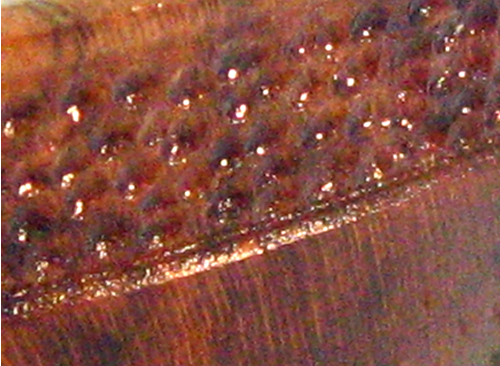
Piece #450 – Ambrosia Maple & Silver Leaf – 5.5″ by 2″ – SOLD


I treated the inside with a solution of tannic acid and water. I let that cure overnight. Next iron water was brushed on over the tannin. Because of the capillary action of the wood fibers the tannin had been absorbed deep into the wood where it intensified the natural tannin found in maple.  The iron water reacted with the tannin changing the wood fiber black. Instant ebony look. Inside bowl then finished with three coats of Salad Bowl Finish.

I put two coats of a nice hard varnish on the outside of the bowl, letting each one cure really well. The next step was adding the Silver leaf and letting the leaf set over night. The chemical patina was applied and once it had the affect I was looking for I rinsed it off and patted it dry. I put the piece aside for three days. I applied 2 coats of Behlen’s Rock Hard Tabletop Varnish, sanding between coats.  Last step was a trip back to the Lathe and the Beall Buffing System.

Roger Dale Scott
WoodPops

450d450a450b

CLOSE UP OF TURQUOISE INLAY

CLOSE UP OF TURQUOISE
INLAY


Golden Camo Bowl # 445

Golden Camo Bowl # 445

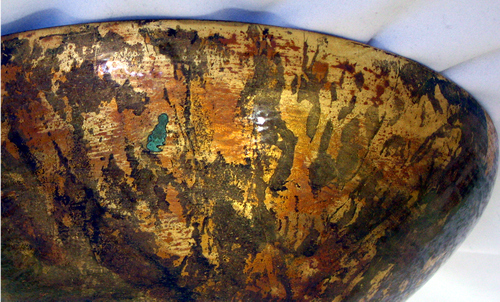
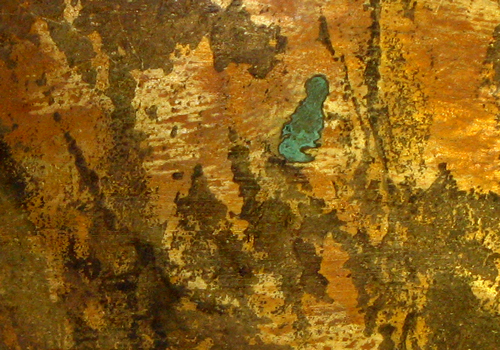
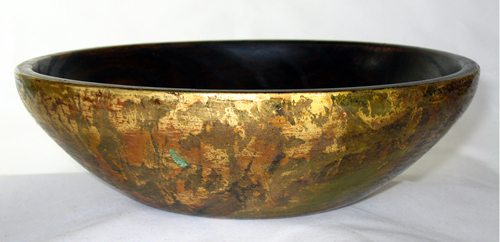
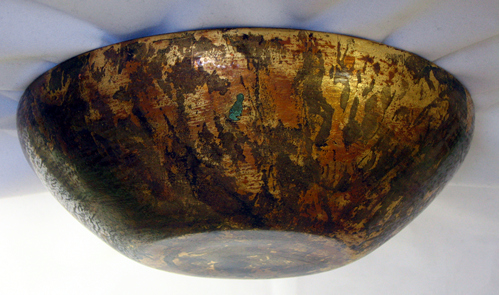
Piece #445 – Oak & Dutch Metal Leaf – 8.5″ by 2.5″ – SOLD


This oak bowl was born plain and characterless. It cried out for some pizzazz. I treated the inside with a solution of tannic acid and water. I let that cure overnight. Next iron water was brushed on over the tannin. Because of the capillary action of the wood fibers the tannin had been absorbed deep into the wood where it intensified the natural tannin found in oak.  The iron water reacted with the tannin changing the wood fiber black. Instant ebony look.
I put two coats of a nice hard varnish on the outside of the bowl, letting each one cure really well. The next step was adding the Dutch Metal leaf and letting the leaf set over night. The chemical patina was applied and once it had the affect I was looking for I rinsed it off and patted it dry. I put the piece aside for three days. I applied 2 coats of Behlen’s Rock Hard Tabletop Varnish, sanding between coats.  Last step was a trip back to the Lathe and the Beall Buffing System

Roger Dale Scott
WoodPops

445d

CLOSE UP

CLOSE UP

445b

Bottom View

Bottom View


Elm Copper Bowl # 441

Elm Copper Bowl # 441

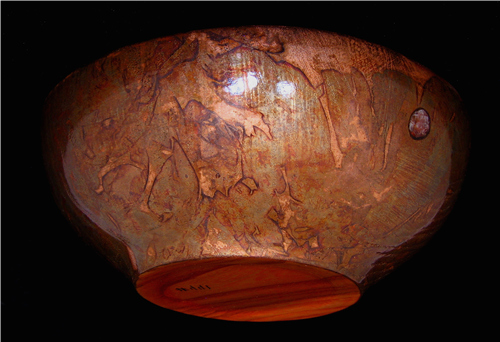
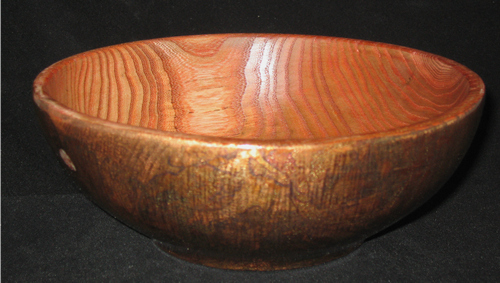
Piece #441 – Elm with Copper leaf – 8″ by 3″

0

My neighbor from down the street gave me this elm last year (2013). This bowl has a very light orange tint on the inside. Then the wood was sealed with a 1 lb. cut of dewaxed shellac. The final finish on the inside is Salad Bowl Finish (food safe). The outside was sealed with varnish to give it a nice hard base for the copper leaf. Go to https://woodpops.com/about-2/gilding-with-patina-finish/ to see my process for adding leaf. Also at https://woodpops.com/gallery/greek-urn/. If you look closely you can see a knot hole that was filled in with calcite crystals. The chemical patina on the copper leaf is orange and compliments the dye tint on the inside. This is a great little bowl.

Roger Dale Scott

Woodpops

441d441c441a

Rose Calcite Burl # 440

Rose Calcite Burl # 440

Piece #440 – Ash Burl with Calcite crystal inlay – 8″ by 4″ – SOLD


This spring I drove up to Baghdad Lumber to pick up the poplar for my new show display shelves. Cal found this ash burl in the back cut-off room. It’s more of a wana-be burl than a full grown burl. However, it has some really interesting character. The rose colored calcite enhances some of the colors running through the burl. It’s a nice piece.

Roger Dale Scott

Woodpops

440a440b440c


Elephant Ear Dish #439

Elephant Ear Dish #439

Piece #439 – Guanacaste, Elephant Ear Tree – 8″ by 1.5″ – May, SOLD


This piece of wood came from Florida. A storm took it down in 2009. I got a lot of it! At the time I thought it was a nasty species. It is almost caustic. I have to take special precautions when I turn it. Now that is has dried out really well it has spectacular character. I only have a couple pieces left. I have made some nice pieces out of it through the years. I will be sorry when I use my last piece.


The dark area is the heart wood

The dark area is the heart wood

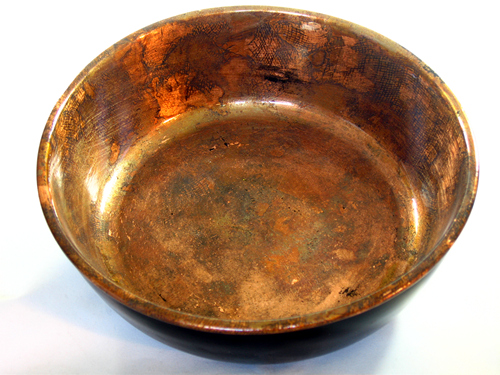
Flash in the Pan #100

Flash in the Pan #100

Piece #100 – River Birch – 8″ by 2.5″ – SOLD


I turned this piece sometime in 2011. Because it had no grain or character I painted it with black lacquer. It sat on my office shelf until May, 2014 when I decided to spiff it up. I applied copper leaf and a chemical patina to the rim and inside. It is too shallow and the bottom is too broad to call it a bowl. The copper is shiny hence the name “Flash in the Pan”.


100b

Brfor the copper leaf

Before the copper leaf


Autumn Splendor #436

Autumn Splendor #436

Piece #436 – Sycamore, Air Brushed – 15″ x 3″

Autumn Splendor is made on the wood lathe from a piece of specimen Sycamore. The tree blew down in the Spring storm of 2011 at Knoxville, TN.  The shape was turned on the lath about 1″ thick at the base and about 5/8″ thick where the leaves start. The piece was sanded to 220 grit sealed with shellac.  The leaves were then penciled in. 

The next step was to cut the edges of the leaves around the outside of the rim. Then I made a relief cut around the inside edges of the leaves at the bottom of the bowl.  Piercing the negative spaces between the leaves was next. Making  the leaves 3 dimensional by relief carving the texture and veins make the look pop. Wood burning the veins with a razor tip completes the wood work. 

The leaves were then sealed with a one lb. solution of dewaxed shellac. After curing, each leaf was individually masked with frisket.   It was now ready to air brush. 

Air brushing the leaves with transparent paint is the secret to realistic, vibrant color. On most leaves I lay down a base coat of yellow. It may vary in shade and amount depending on what color I want to end up with. Next comes the red, orange or green layered on lightly in the areas I want the heavier color. A red leaf has a base coat of pink instead of yellow. The same for the purple leaves. Once the leaf looks good I go back and add a touch of shading grey to create shadows. It is important to remember, “Less is More”. 

After the paint cures for several days I apply no less than five coats of satin lacquer from a spray can. Two hours between coats so that I do not have to sand. The display stand is finished with gloss brushing lacquer. 

Roger Dale Scott WoodPops


Ebony like Natural Edge Bowl # 435

Ebony like Natural Edge Bowl # 435

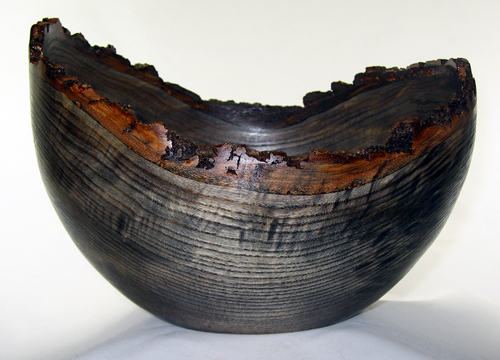
Piece #435 – Ash – 10″ by 6″ – SOLD


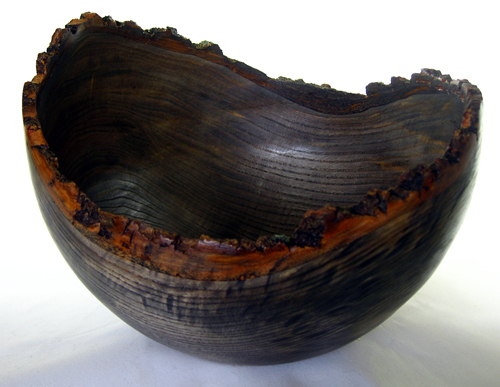
I like natural edge bowls with lots of figure (character). However, this Ash bowl had lots of character but not the kind that looks good. OK. What to do.

At the time I’m making new portable shelves for the art shows planned for this year. They are made from cheap rough cut poplar that I plan to ebonize with the iron water and tannis technique. Why not try it on this bowl?

Turned out pretty darned good. I’m a genius, and modest too.


435b435e435c435f435d