May 19, 2014
Piece #437 – Walnut – 10.5″ by 4″ – SOLD
This walnut bowl has five coats of milk paint. The first two are red. The third is blue and the last two are red. I have scuffed through them in a couple of places to make the bowl look old.
Oct 2, 2009
This western style bowl was a Christmas Present to my Sister in AZ. Merry Christmas Sandy.
Oct 2, 2009
I donated this piece to a woman’s club for a silent auction fund raiser to be held in February. The bowl sold for $150.00.
Oct 2, 2009
SOLD
Oct 2, 2009
NFS
Sep 21, 2009
Made from Walnut, Hack-berry and Maple.
Sep 21, 2009
Made from European Steamed Beech.
Sep 21, 2009
This red oak record cabinet has a stained glass door.
Sep 21, 2009
Made from red oak.
Sep 16, 2009
NFS
This beautiful Maple vase was born out of disaster! I was turning a larger vessel and my fingernail gouge caught hold of a knot edge. BAM! I had been working on this piece for a long time and had some time invested. After a few choice curse words and a respectable amount of lamenting I examined the pieces and this phoenix was born.
The spalted maple figure in this vase is quite striking. The base is 5 inches in diameter and the body is 8 inches tall. A really nice arrangement of ferns and peacock feathers compliment the vase.
This spalted maple vase makes a great home decoration and would be an unusual wedding gift or birthday gift. Not only is it one of a kind, but it is hand crafted by a future great American master – Me.
Sep 16, 2009
SOLD
This Poplar canister, or “BOX” as we wood turners call them, is an experiment in design and color. The box is 9 inches tall and 4 inches in diameter. The walls are about 1/4 inch thick and the lid is a snug fit. The colors were produced by a multistage process and a variety of art mediums.
The first step was sanding the finished piece with 80 through 220 grit 3M aluminum oxide sandpaper. Next I put on a coat of MINWAX sanding sealer and let dry for 24 hours. After a light sanding with 220 sandpaper I sprayed the piece with gloss red paint and let dry for 4 hours. I then sprayed on some very miner highlight streaks using gloss black acrylic paint. Upon complete curing I covered the box with MINWAX gloss polyurethane and let dry for about three days.
I had just finished a turning class with David Marks, sponsored by my local Woodcraft store and wanted to try David’s process of metal leaf gilding. I sized the piece with one hour size. Using David’s techniques I laid on copper and fake gold leaf leaving about 10% of my painted surface showing. I set the work aside for 24 hours to cure.
The next day I set my work table up outside and donned my hazardous material garb. Using David’s suggested chemicals and application supplies I produced different chemical reactions on the metal leaf resulting in the final colors on the box. I set it aside for about a week before I applied three finishing coats of MINWAX gloss polyurethane.
Sep 16, 2009
sold
I wanted to turn a piece of green wood to see how it would move as it dried. When this blank of oak was just cut I wrapped it in shrink wrap so it would not check (crack). I let it cure in my garage for about 8 weeks. When I unwrapped it there was this black crust on the end grain and it was quite moist.
I scraped off the mold and mounted it on my lathe. I shaped and hollowed it in about three hours. The finished piece went straight from the lathe into a five gallon bucket of denatured alcohol for a 12 hour soaking. The next morning the piece was removed from its bath and placed on a drying wrack. After about two hours I wrapped the dried pot in three paper grocery bags and stuffed it into my closet.
A month later I removed the Spalted Oak Pot from the closet and finished it my usual way. From the time the piece was cut from the tree to the finished product was about 3 months. Although the pot did not check, it moved quite a bit. You can not see it from this picture but there is a significant bulge to one side making this Spalted Oak Pot quite striking in its shape and color. All in all I pronounced this technique a success.
Sep 16, 2009
Piece #123 – Turkey Oak – 6″ dia by 8″ tall – SOLD
This very unusual gourd looking vessel is part of my “Worm Hole” collection that came from the Turkey Oak tree I cut down in my back yard. (If you haven’t read that posting, you should; it’s quite funny.) The tree was infested with worms producing the holes you see in this vessel.
It is 8 inches tall and 6 inches in diameter with a loose fitting lid. The figure and color combined with the worm holes give this Oak Vessel an abundance of character.
This work of art would look great in a country kitchen decor. You could even keep your teabags stored inside. There is nothing as rich and warm as a great piece of wood properly displayed. I also love the feel of wood texture and can often be found in my shop rubbing my wood.
Sep 16, 2009
Sold
This Oak form has two holes. One in the top and the one in the front. Of course the one in the top was necessary to hollow out the form. The one in the front developed as I hollowed out the piece. As you can see the bark remains on the front of the piece which is what I wanted – a natural side showing as much bark as possible. I also wanted the walls to be as thin as I dared. The oak blank I turned this piece from had a small inclusion (dent). As I turned the inside hollow, the sap wood was thinner under the inclusion and the hole formed.
Not to fret. The location, shape and size of the front hole adds to the character presented by the bark face. This makes the piece unusual and pleasing to the eye. It adds an element of surprise to this Form.
The Oak for this piece came from our friend’s forest in Andrews, NC. I returned it to them and now it resides on their fireplace mantle.
Sep 15, 2009
Piece #148 – Ear Tree – 5″ dia by 9″ tall – SOLD
This hand crafted flower vase in made from the Guanacaste tree (ear tree). The heartwood is dark and rich while the sapwood is white. The end grain is very stringy, fuzzy or fibrous and difficult to turn. It is a hardwood but is very light in weight.
The ivy is hand carved and dyed green. The dark lines were burned in. Look at the contrasting shades of the wood from front to back.
Sep 15, 2009
Given to my Sister-in-law for Christmas. Merry Christmas Maggie.
This Oak pedestal bowl has a partial dipped natural edge. It was made to display pine cones. My wife loves pine cones displayed in a nice arrangement. This bowl shows off the natural bark rim contrasted next to the pine cones. The bowl is 8 inches in diameter and 4.5 inches tall.
Sep 15, 2009
Piece #114 – Natural Spalted Oak – 6″ dia by 5″ – Sold
This oak closed form is 6 inches in diameter and 5 inches tall. The entire top was left with the natural bark of the oak tree. The wall thickness is about 1/2 inch. The oak sap wood has spalted leaving the unusual figure and color in the wood.
Sep 15, 2009
Sold
Sep 15, 2009
Piece #134 – Beech – Sold
Sep 15, 2009
Piece #111 – Maple – Sold
Sep 9, 2009
Piece #158 – Oak – 8.5″ dia x 5.5″ – Sold
This piece was sold on June 4th at the Lenoir City Arts and Crafts Festival.

Sep 9, 2009
Piece #117 – Chinese Elm – 10″ dia by 6″ – SOLD
This natural edge bowl is turned from Chinese Elm. It is 10 inches at it’s widest and 6 inches deep. Notice the random spikes of heartwood shooting out from the pith in the center. Very dramatic. The bark left on the upper sides of the bowl add an element of surprise to catch the eye. This is an awesome piece of art, even if I do say so myself.
Side View
This was a very difficult piece of wood to turn because of its very odd shape and hollowing the end grain. The bowl is cut from the middle of the tree so that the center of the dish is the pith surrounded by the heartwood. Next is the sapwood and exterior bark. I could only turn the center out to about 6 inches because the lathe spins the wood in a true circle. When the bottom and lower walls were the right thickness I parted the piece from the lathe.
From this point on it was all hand work. I roughed out the rest of the bowl sides with my Dremel® and a number 115 high speed cutter. Once the bulk of material was removed I switched to my one inch ball die grinder fastened to my air compressor. This tool was used to bring down the high spots. Next I switched to a round hand scraper. Using much elbow greese and a lot of patience I thinned down the wall to a relativly uniform thichness. From this point I sanded with 80 grit sandpaper through 220 grit then applied Minwax® Tung Oil Finish to bring out the color in the wood. I let this dry about a week. I then applied three coats of Minwax® Polyurethane semi-gloss.
This would make a great wedding gift.
Aug 31, 2009
Piece #153 – Spalted Oak with copper leaf – 4.5″ diam by 15″ tall – SOLD
This oak pitcher is made from spalted oak. The copper leaf is around the black knot near the bottom and extends almost all the way around. My first step was to apply gilders size and lay down copper leaf on the area I wanted the copper. I let the piece dry for about a week.
To patina the copper I start the process by spraying the piece with a fine mist of water. Tissue paper was laid on randomly making sure it covered and adhered to the dampened copper. Next I dab on a solution of sodium sulfide with a piece of sponge, making sure to cover all of the dampened tissue paper. This was left to soak through the tissue and react with the copper for about 60 seconds. Using paper towels I remove the soaked tissue paper and then dab the surface dry with fresh paper towels to remove any residual sodium sulfide and stop the chemical reaction.
Aug 10, 2009
Piece #154 – Poplar & Copper Leaf Patina – 5″ diam by 9″ tall – SOLD
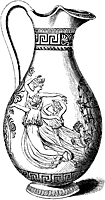
This Greek pitcher is made from poplar. It was turned on my lathe then hand carved using my portable dremel and hand chisels. It is nine inches tall and five inches in diameter. This poplar pitcher was first finished with sanding sealer. After a light sanding I applied three coats of black acrylic gloss spray paint sanding lightly with 220 paper between coats. After about five days I applied copper leaf on about 95% of the piece. The next day I sponged on a Sodium Sulfide and water solution using tissue paper and a cut sponge. I let it react for about three minutes and then dabbed dry the pitcher with paper towels.